Due Diligence in Mexico: Managing FTO and Cartel-Related Risk
If your business is investing in Mexico, appointing local partners, vetting suppliers, or moving goods through the country, due diligence is no longer a box‑ticking exercise; it is a core risk‑control function. The right review surfaces hidden ownership, unreliable intermediaries, litigation or fraud indicators, supply‑chain weaknesses, and links to organised crime before they turn into legal, financial, or reputational problems.
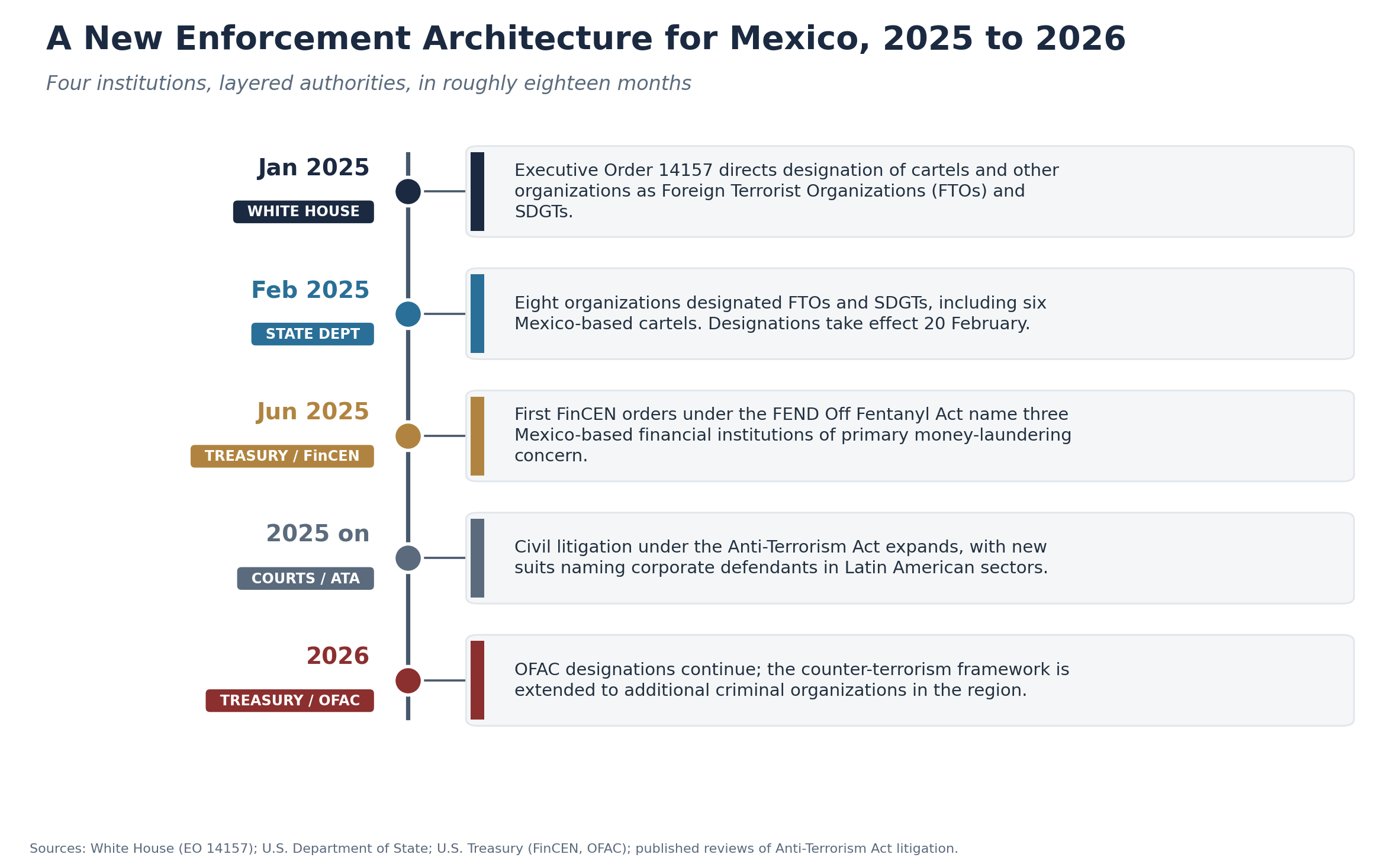
In early 2025, the United States brought several Mexico-based cartels within its counter-terrorism legal framework. Executive Order 14157, signed in January 2025, started the process, and on 20 February 2025 the United States designated eight Latin American crime groups, six of them Mexican cartels. The two labels carry different tools: a Foreign Terrorist Organization (FTO) designation, made by the State Department, makes it a federal crime to knowingly provide material support to the group, while a Specially Designated Global Terrorist (SDGT) designation, made by the U.S. Treasury, freezes the group's U.S. assets and bars U.S. persons from dealing with it.
The practical effect is what matters for business. Support need not be direct: paying, supplying, or servicing a designated group through an intermediary may still create exposure where the company knew, or was willfully blind to, the relevant facts. Nor must a company be American to be caught: U.S. dollar payments, banks, insurers, customers, or financing can each bring a transaction within U.S. reach. In short, cartel risk in Mexico is no longer only a security issue; it is now a criminal, sanctions, and civil‑liability risk.
Why due diligence in Mexico now requires a higher standard
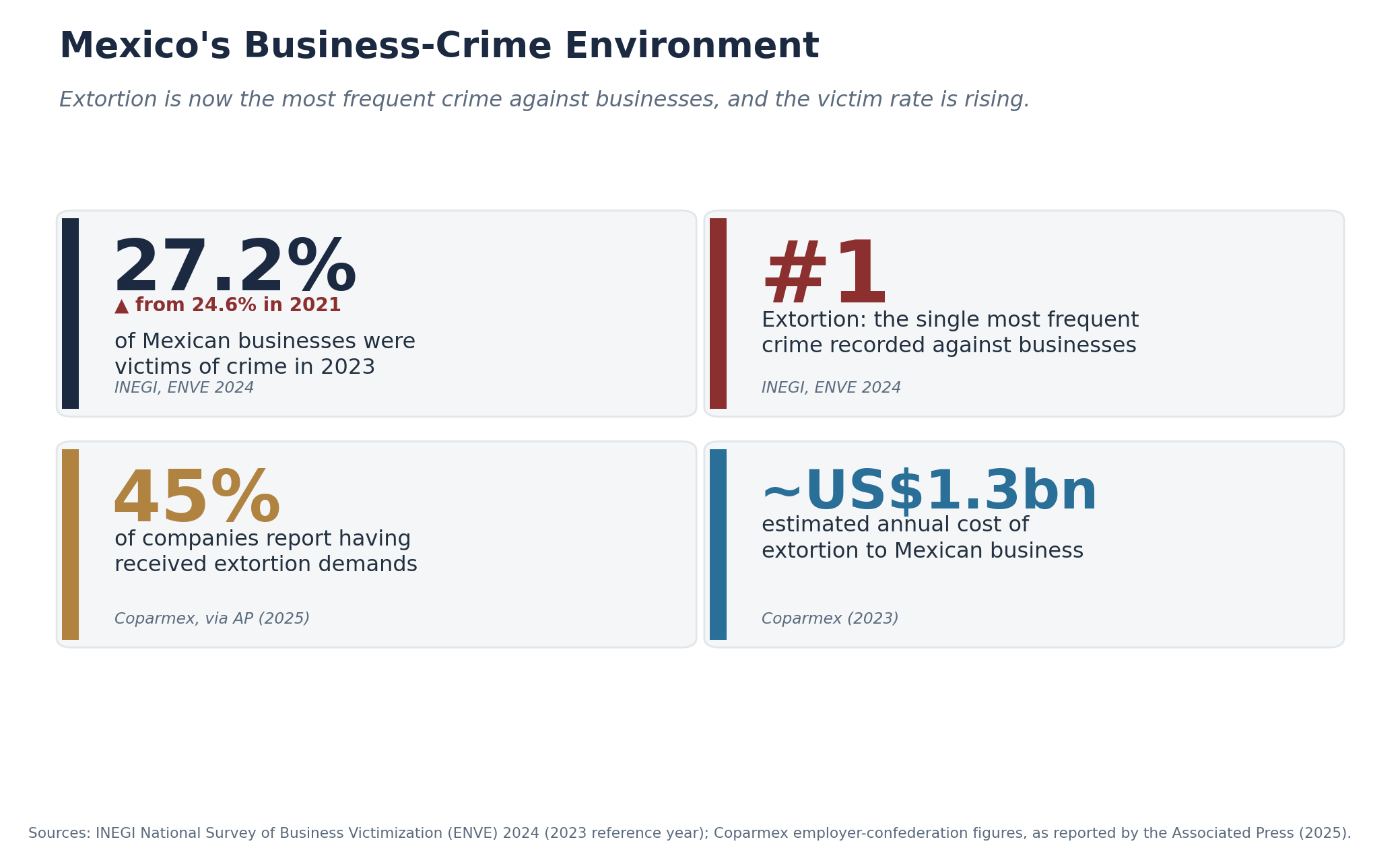
Mexico remains an important manufacturing, logistics, investment, and sourcing market. But it is also a jurisdiction where extortion, criminal control of territory, hidden intermediaries, and cartel‑linked commercial pressure can affect otherwise ordinary business activity. The Associated Press has reported that extortion is forcing some businesses to pay, scale back, or close, with recorded cases rising sharply in early 2025 even as other crimes fell. Reuters has documented an expanding investigation into cartel‑linked fuel smuggling through Mexican seaports, a trade the U.S. government now ranks as the cartels' second‑largest revenue source after narcotics. In Michoacán, repeated extortion of lime and avocado producers has forced citrus packing houses to suspend operations.
For that reason, due diligence in Mexico should not be limited to a database screen. A counterparty may look clean on paper while the real risk sits behind it: an undisclosed beneficial owner, a subcontractor you were never told about, an unexplained payment intermediary, a warehouse in a contested corridor, or a “security” or “route access” fee that masks criminal control.
What standard screening misses
Standard sanctions screening usually catches the easy cases: named individuals, named entities, and obvious list matches. It very often misses the harder ones. Under 18 U.S.C. § 2339B, knowingly providing material support to a designated FTO can trigger criminal exposure, and the statute is broad enough to cover many forms of practical support. Under 18 U.S.C. § 2339A, “material support or resources” is defined to include currency, financial services, lodging, expert advice or assistance, personnel, and transportation. The statute also has extraterritorial reach.
That is why hidden ownership, control, and indirect benefit matter. OFAC’s 50 Percent Rule provides that any entity owned 50 percent or more, directly or indirectly and in the aggregate, by one or more blocked persons is itself treated as blocked, even if it does not appear by name on a sanctions list. A name-screen will not detect nominee shareholders, layered ownership, informal control, subcontracted performance, or a payment flow that ultimately benefits a designated group. If a company does not establish who owns, controls, performs, and benefits from the relationship, it may miss the real risk entirely.
Civil exposure can be equally significant. Under 18 U.S.C. § 2333, U.S. nationals injured by acts of international terrorism may bring civil claims for treble damages, and liability can extend to parties that knowingly provide substantial assistance. The Chiquita and Lafarge matters illustrate the scale of that risk. Chiquita paid a $25 million criminal fine and later faced a 2024 civil verdict of $38.3 million. Lafarge became the first corporation prosecuted by the U.S. Department of Justice for material support of terrorism and agreed to pay more than $777 million. The lesson for companies operating in Mexico is straightforward: indirect support, legacy relationships, and poorly documented counterparty decisions can create exposure long after the underlying commercial activity has taken place.
What enhanced due diligence in Mexico should cover
A properly scoped due-diligence review in Mexico should answer the questions that determine real exposure. Who ultimately owns and controls the counterparty? Is the counterparty’s commercial profile consistent with its stated role, assets, revenues, and operating history? Who will actually perform the work? Which routes, ports, facilities, subcontractors, agents, and intermediaries are involved? Do local records or media sources indicate litigation, fraud, corruption, regulatory issues, criminal exposure, or reputational concerns? Do the payment flows, banking relationships, unexplained fees, or local access arrangements create indirect sanctions or material-support risk? If a concern is identified, can the company demonstrate that it was escalated, investigated, assessed, mitigated, and documented?
In practice, enhanced due diligence in Mexico may include beneficial-ownership analysis, corporate and public-records review, adverse-media and litigation checks, source-of-funds review where appropriate, supplier and subcontractor mapping, site verification, route-risk assessment, payment-flow analysis, and discreet local enquiries where database screening is insufficient.
The objective is not simply to confirm whether a party appears on a sanctions list. It is to establish who controls the relationship, who benefits from it, how the work will be performed, and whether the company has a defensible basis to proceed before a transaction closes or a commercial relationship deepens.
Frequently Asked Questions
What is due diligence in Mexico?
Due diligence in Mexico is the process of checking a company, individual, supplier, intermediary, or transaction before you invest, contract, acquire, or onboard. Depending on the risk, that can include ownership checks, litigation searches, adverse media, site verification, source-of-funds review, subcontractor mapping, and local intelligence work.
Why is enhanced due diligence in Mexico important now?
It is more important because the U.S. legal landscape changed in 2025. The January 2025 executive order and the February 2025 cartel designations raised the consequences of indirect commercial exposure, especially where U.S. jurisdiction, finance, customers, or banking channels are involved.
Is sanctions screening enough?
Usually not. OFAC warns that blocked ownership can exist indirectly and in the aggregate, and 18 U.S.C. § 2339B reaches a broad range of material support. Screening is an important first step, but not a substitute for ownership analysis and operational due diligence.
Who should commission due diligence in Mexico?
Typical users include investors, acquirers, lenders, manufacturers, importers, compliance teams, law firms, and businesses appointing distributors, brokers, suppliers, or local representatives in Mexico. That need is especially acute in sectors exposed to logistics, cash-intensive operations, agricultural supply chains, ports, customs, or local permitting and site access.
Due diligence services in Mexico
Warden Consulting provides enhanced due diligence in Mexico for companies, investors, compliance teams, and law firms. Our work includes beneficial ownership analysis, adverse-media and litigation checks, local public-records research, source-of-funds review, supplier and site verification, and discreet field enquiries where database screening is not enough, with particular focus on cartel, sanctions, and FTO-related risk. The aim is straightforward: to establish who the counterparty really is, identify material risk before commitment, and provide a documented basis for the decision before a transaction closes or a commercial relationship deepens.
Learn more about Warden Consulting’s due diligence services in Mexico, or contact our Mexico City team for a confidential review.